DOUTEUR EST L'AMI DE MONSIEUR MARCEL DUCHAMP

DOUTEUR EST L'AMI DE MONSIEUR HENRY DICKSON ET DE MONSIEUR MARCEL DUCHAMP ET L'AMI DE DAME MUSE ET DES MUTANTS GÉLATINEUX LGBTQ OGM ET DE MADEMOISELLE TAYTWEET DE MICROSOFT - SECONDE TENTATIVE OFFICIELLE D'Ai - INTELLIGENCE ARTIFICIELLE - ET DE MONSIEUR ADOLF HITLER, CÉLÈBRE ARTISTE CONCEPTUEL AUTRICHIEN ALLEMAND CITOYEN DU MONDE CÉLÈBRE MONDIALEMENT CONNU - IL EST DANS LE DICTIONNAIRE - SON OEUVRE A ÉTÉ QUELQUE PEU CRITIQUÉE MAIS ON NE PEUT PLAIRE À TOUT LE MONDE ET PERSONNE N'EST PARFAIT ! VOILÀ!

DOUTEUR EST L'AMI DU PROFESSEUR BULLE QUI EST L'AMI DE DOUTEUR

DOUTEUR EST L'AMI DU PROFESSEUR BULLE QUI EST L'AMI DE DOUTEUR
DOUTEUR - DE LA FÉDÉRATION INTERNATIONALE DU DOUTE EST AMI DU PROFESSEUR BULLE - DE L'INTERNATIONALE SITUATIONISTE CONSPIRATIONNISTE - DES THÉORICIENS DU COMPLOT ET DES CONSPIRATIONS ET DES COMPLOTISTES ET CONSIRATIONISTES - AMI DES THÉORICIENS DU NON COMPLOT ET DES THÉORICIENS DE L'EXPLICATION ET DE L'UNION DES JOVIALISTES ET INTELLECTUELS ORGANIQUES - AUTISTE ASPERGER GEEK RELATIVISTE CULTUREL PYRRHONIEN NÉGATIONNISTE RÉVISIONNISTE SCEPTIQUE IRONIQUE SARCASTIQUE - DÉCONSTRUCTEUR DERRIDADIEN - AMI DES COLLECTIONNEURS DE BOMBES ATOMIQUES - AMI DES PARTICULES ÉLÉMENTAIRES ET FONDAMENTALES ET AMI DE L'ATOME CAR LA FUSION OU LA FISSION NUCLÉAIRE SONT VOS AMIS

UN JOUR LES MUTANTS GOUVERNERONT LE MONDE - CE NE SERA PROBABLEMENT PAS PIRE QU'EN CE MOMENT

UN JOUR LES MUTANTS GOUVERNERONT LE MONDE - CE NE SERA PROBABLEMENT PAS PIRE QU'EN CE MOMENT
LES MUTANTS EXTERMINERONT OU NON LES HUMAINS - ET NOUS TRAITERONS PROBABLEMENT AUSSI BIEN QU'ON SE TRAITE NOUS-MÊMES ENTRE NOUS - ET PROBABLEMENT AUSSI BIEN QUE L'ON TRAITE LA NATURE ET TOUT CE QUI VIT
Aucun message portant le libellé Al-Shabab. Afficher tous les messages

dimanche 28 juin 2015

6617. ART CONTEMPORAIN. ÉTUDE DE LA PLANÈTE ET DE SES HABITANTS PROVISOIRES


INSIDE AN AL-SHABAAB TRAINING CAMP


*
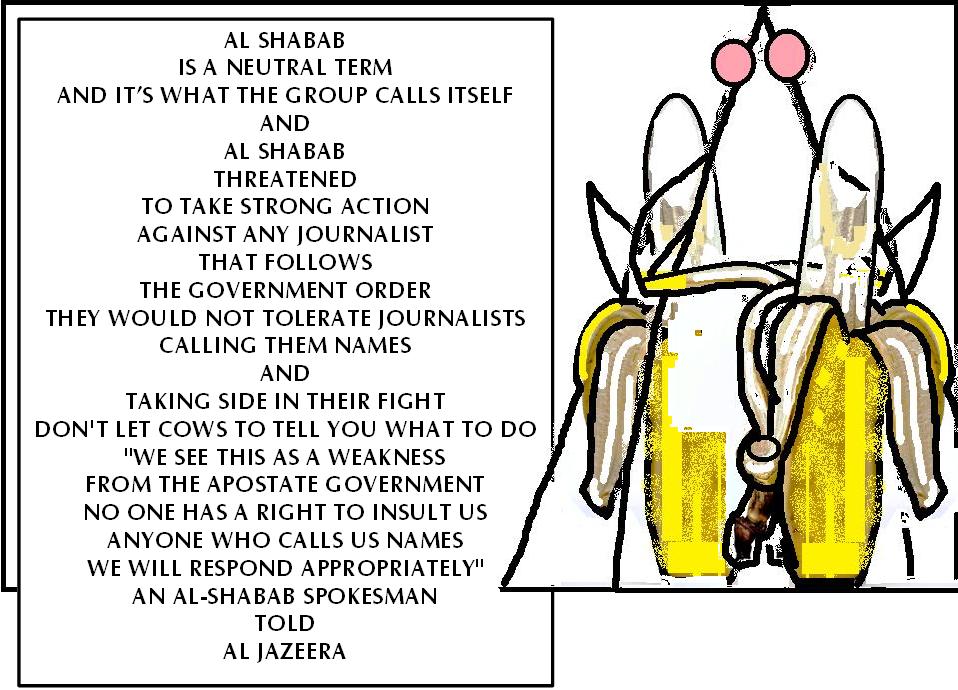
SOMALIA'S GOVERNMENT BAN AL-SHABAB NAME FROM MEDIA
4 May 2015


*
UNRAVELLING AL-SHABAAB’S PARTIAL INTERNET BAN AND SIMILAR STUNTS IN SOMALIA

BY SOMALIA NEWSROOM on january 13, 2014  
 

*

WHAT’S IN A NAME?: SOMALI GOVERNMENT’S AL SHABAB MEMO JEOPARDIZES JOURNALISTS

June 19, 2015


*

BOTH SOMALIA'S GOVERNMENT AND AL-SHABAAB BAN EACH OTHER'S NAME FROM MEDIA

Tuesday May 05, 2015 


*

SOMALIA’S GOVERNMENT JUSTE BANNED CALLING LA SHABAB BY ITS NAME

WAR IS BORING


*

SOMALIE

2013 TRAFFICKING IN PERSONS REPORT

SPECIAL CASE


*

SOMALIA

COUNTRIES/JURISDICTIONS OF PRIMARY CONCERN - SOMALIA

BUREAU OF INTERNATIONAL NARCOTICS AND LAW ENFORCEMENT AFFAIRS

2015 INTERNATIONAL NARCOTICS CONTROL STRATEGY REPORT (INCSR)
REPORT


*

SOMALIA

THE PROVISIONAL FEDERAL CONSTITUTION (PFC) PROVIDES FOR THE RIGHT OF EACH INDIVIDUAL TO PRACTICE ONE’S RELIGION.

Executive Summary


1

The constitutions of Somaliland and Puntland State enshrine Islam as the state religion, prohibit Muslims from converting to another religion, bar the propagation of any religion other than Islam, and stipulate all laws must comply with the general principles of sharia.

2

Al-Shabaab maimed and killed persons suspected of converting from Islam or those who failed to adhere to the group’s edicts.

3

Violent conflicts continued between the terrorist organization al-Shabaab and the FGS and its allies. Through violence, Al-Shabaab imposed its own interpretation of Islamic law and practices on other Muslims. Al-Shabaab militias killed FGS officials and their allies, calling them non-Muslims or apostates. 

In the areas it controlled, al-Shabaab banned cinemas, music, and watching sporting events on television. It prohibited the sale of khat (a popular narcotic), smoking, and any behavior it characterized as “un-Islamic,” such as shaving beards. 

Al-Shabaab also enforced a strict requirement that women wear full veils

*

SOMALIA

U.S. DEPARTMENT OF STATE

DIPLOMACY IN ACTION

U.S. Relations With Somalia


*

U.S. RELATIONS WITH SOMALIA

BUREAU OF AFRICAN AFFAIRS

FACT SHEET

SOMALIA

June 15, 2015


*

AL-SHABAAB

BACKGROUND


1

The Harakat al-Shabaab al-Mujahidin—commonly known as al-Shabaab—was the militant wing of the Somali Council of Islamic Courts that took over most of southern Somalia in the second half of 2006.

2

Despite the group’s defeat by Somali and Ethiopian forces in 2007, al-Shabaab—a clan-based insurgent and terrorist group—has continued its violent insurgency in southern and central Somalia.

3

The group has exerted temporary and, at times, sustained control over strategic locations in those areas by recruiting, sometimes forcibly, regional sub-clans and their militias, using guerrilla warfare and terrorist tactics against the Somali Federal Government (SFG), African Union Mission in Somalia (AMISOM) peacekeepers, and nongovernmental aid organizations.

4

As of 2013, however, pressure from AMISOM and Ethiopian forces had largely degraded al-Shabaab’s control, especially in Mogadishu but also in other key regions of the country, and conflict among senior leaders has exacerbated fractures within the group.

5

In 2013 al-Shabaab rivalries culminated in a major purge of opponents of deceased group leader Ahmed Abdi Aw-Mohamed.

*

HUMAN RIGHTS WATCH

WELCOME TO THE OFFICIAL WEBSITE OF THE GOVERNMENT OF SOMALIA


SOMALIA NEWS AND INFORMATION CENTER


AUGUST 2014. SOMALIA REDUX ? ASSESSING THE NEW SOMALI FEDERAL GOVERNMENT


WELCOME TO THE OFFICIAL WEBSITE OF THE GOVERNMENT OF SOMALIA
POLITICAL PARTIES LINKS WITH TERRORISM


ARS-Djibouti is party of the Unity Government of the Democratic Republic of Somalia

ARS-Asmara is the official Opposition against the Democratic Republic of Somalia, and is led by Hassan Dahir Aweys

Union of the Islamic Court (UIC) was dismantled into two known groups: ARS-Djibouti and Ars-Asmara

Al-Shabaab is youth organization which has links with the well-known Al-qadea Organization and is one of the first terrorist list in Horn of Africa

RELIGIOUS PARTIES

Ahalusunna Waljameeca is very friendly and 85% of the Somali Pollution are Ahlausuna Wajameeca and classified as non-violant organization that has enjoying popularity among the Somalis wherever they live.

HISBUL ISLAAM is another terrorist groups that is trying to topple Somali's current regime and will also invent to dismantle and disrupt neighboring security and regimes if they overthrown the current regime of Somalia.

Wahabism is considered one of the dangerious and modern threat to Somalia's religious creed because they tried to posses and demolish the Ahlu Sunna Waljameeca sect.

Akhwanul Muslimiin is very good and keep low profile themselves.

Tafiir is another dangerious sect, and has been trying to pursue fellowers but confined in solitary status and do not interact with the rest of other groups

Saalaxiya is very nice and has patience and religious tranquality, and they have operating friendly.

*

20-YEAR-LONG CONFLICT IN SOMALIA

YOU DON’T KNOW WHO TO BLAME’: WAR CRIMES IN SOMALIA

Human Rights Watch

August 14, 2011

The 58-page report, “‘You Don’t Know Who to Blame’: War Crimes in Somalia,” documents numerous abuses during renewed fighting in the past year by parties to the 20-YEAR-LONG CONFLICT IN SOMALIA.

1

These include the Islamist armed group al-Shabaab, the Somali Transitional Federal Government (TFG), the African Union peacekeeping forces (AMISOM), and Kenya- and Ethiopia-backed Somali militias.

The report also examines abuses by the Kenyan police and crimes committed by bandits in neighboring Kenya against Somali refugees.

2

Somalia's crisis isn't just about drought. HRW's Ben Rawlence explains how war crimes have helped fuel the crisis in Somalia.

3

All parties to Somalia’s armed conflict have committed serious violations of the laws of war that are contributing to the country’s humanitarian catastrophe, HUMAN RIGHTS WATCH said in a report released today.

All sides should immediately end abuses against civilians, hold those responsible to account, and ensure access to aid and free movement of people fleeing conflict and drought.

4

All sides have used artillery in the capital, Mogadishu, in an unlawful manner that has caused civilian casualties. Al-Shabaab has fired mortars indiscriminately from densely populated areas, and the TFG and AMISOM forces have often responded in kind with indiscriminate counterattacks.

As a result, civilians have not known where to turn for protection.

5

The TFG has largely failed to provide basic security and human rights protections in the limited areas under its control, Human Rights Watch said.

It and its allied militias have committed serious rights violations, including widespread arbitrary arrest and detention, restrictions on free speech and assembly, and indiscriminate attacks harming civilians.

6

Ethiopia and Kenya are parties to the conflict, having deployed units of their armed forces in military operations in southern Somalia in 2011. They have also provided military assistance to militias supporting the TFG.

Yet neither Ethiopia nor Kenya has acted to ensure accountability for abuses by their troops or by the militias they support.
5
Ethiopian military intervention ousted a coalition of Islamic courts from power.

Although Ethiopian forces withdrew from the city by January 2009, insurgents continue to fight the transitional government and its Supporters

7

In May 2010 the armed opposition - including al-Shabaab and Hizbul Islam insurgents - began a new offensive to topple the TFG, which is recognized internationally.

THE TRANSITIONAL GOVERNMENT controls only a few areas of Mogadishu.

It is backed by more than 8,000 peacekeeping  troops from the African Union Mission in Somalia (AMISOM), and Ahlu Sunna Wal Jamaa militias, a moderate Somali Islamic group erratically allied to the transitional government.

*

SOMALIE

MÉMO À L’ONU

DISPUTE TERRITORIALE


*

SISTER SOMALIA, THE FIRST RAPE CRISIS CENTER IN MOGADISHU, 

SUPPORTS SOMALI SEXUAL VIOLENCE SURVIVORS 
BY PROVIDING COUNSELING, MEDICAL SERVICES, RELOCATION, EDUCATION, AND BUSINESS STARTER KITS.


*

BLAMING THE VICTIMS OF RAPE IN SOMALIA

FATIMA HAD BECOME UNCHARACTERISTICALLY TACITURN, TELLING HER AUNT TO ABANDON HER, TO "CONSIDER HER ALREADY DEAD".

SHE "BECAME HOPELESS" AND ATTEMPTED SUICIDE BY SETTING HERSELF ON FIRE

May 6, 2015

Mogadishu (AFP)

14-year-old Fatima was raped by a tuk-tuk driver, she was arrested, detained for a month and raped repeatedly by a police officer, according to the child and her aunt.

The man was released and Fatima was accused of being a prostitute.

Sexual violence is widespread in Somalia and rarely prosecuted. If anyone is punished at all it is often the victim, not the perpetrator.

When it comes to rape cases in the socially conservative Horn of Africa nation, blaming the victim is the norm -- and there have been no consequences for Fatima's uniformed attackers.

A slight girl no more than five feet (150 centimetres) tall, she lives in one of the squalid camps for the uprooted that dot the city. The UN children's agency UNICEF says young women and girls in the camps are "systematically preyed upon", frequently by armed personnel.

Last year the advocacy group Human Rights Watch accused some members of the 22,000 African Union force in Somalia of rape and sexual exploitation.

Other forms of sexual violence and abuse, including the near-universal female genital mutilation -- the cutting off of the clitoris -- and widespread forced and early marriage.


*

THE FIRST PUBLIC ART MUSEUM IN JAPAN DEVOTED EXCLUSIVELY TO CONTEMPORARY ART, IT IS LOCATED IN THE HIJIYAMA PARK, WHICH HAS A SPLENDID VIEW OF HIROSHIMA AND IS FAMOUS FOR ITS CHERRY BLOSSOMS.


GOETHE INSTITUT


*

[360°] DÔME DE LA BOMBE ATOMIQUE DE HIROSHIMA, PATRIMOINE MONDIAL

MUSÉE DU MÉMORIAL DE LA PAIX D'HIROSHIMA


LES LANTERNES SONT ALLUMÉES À LA « FLAMME DE LA BOMBE ATOMIQUE»,

Des braises trouvées par Yamamoto Tatsuo, un soldat affecté à Hiroshima, dans les décombres de la librairie de son oncle, un mois après le bombardement. Cette flamme est aujourd’hui conservée à Hoshino, petit village dans la préfecture de Fukuoka.

Le Musée du Mémorial de la Paix d'Hiroshima a continuellement appelé à l'abolition de des armes nucléaires et à la réalisation d'une paix permanente à travers le monde.

Le musée est séparé en « bâtiment est » et en «bâtiment principal». Dans le « bâtiment est », l'histoire de Hiroshima « Hiroshima no ayumi » consacrée à LA PÉRIODE DE L'ATOMISATION est présentée par l'intermédiaire d'une exposition de panneaux de photos, de films et de maquettes basés sur des faits liés au cadre historique de l'époque.

Dans le « bâtiment principal », le musée expose en détail l'état de Hiroshima dévasté par la bombe atomique.

Le Parc Commémoratif de la Paix où se situe le musée est un endroit bien connu pour ses cerisiers


vendredi 26 juin 2015

6615. ART CONTEMPORAIN. DES DIZAINES DE MORTS DANS UNE ATTAQUE D’AL-SHABAB EN SOMALIE. LES ISLAMISTES DU GROUPE AL-SHABAB ONT ATTAQUÉ VENDREDI À L'AUBE UNE BASE DE LA FORCE DE L'UNION AFRICAINE (UA) ET ONT TUÉ DE NOMBREUX SOLDATS. UNE VOITURE CHARGÉE D'EXPLOSIFS A FONCÉ SUR LA BASE ET D'INTENSES COUPS DE FEU ONT ÉTÉ ÉCHANGÉS, SELON UN RESPONSABLE DE LA RÉGION. LES FORCES DE L'UA ONT OUVERT LE FEU SUR LE VÉHICULE QUI A RÉUSSI À SE FRAYER UN CHEMIN. UN PORTE-PAROLE DU GROUPE AFFILIÉ À AL-QAÏDA A DÉCLARÉ QUE PLUSIEURS ACTIVISTES AVAIENT PÉNÉTRÉ DANS LA BASE ET QUE DE VIOLENTS AFFRONTEMENTS SE POURSUIVAIENT À L'INTÉRIEUR DU SITE. LE RESPONSABLE DE LA RÉGION A INDIQUÉ QU'IL Y AVAIT AU MOINS 25 SOLDATS TUÉS. D'AUTRES TÉMOINS PARLENT DU DOUBLE DE VICTIMES. AUCUN BILAN OFFICIEL N'A ENCORE ÉTÉ FOURNI.

DES COMBATTANTS D'AL-SHABAB 
DES DIZAINES DE MORTS DANS UNE ATTAQUE D’AL-SHABAB 
EN SOMALIE

vendredi 26 juin 2015

http://ici.radio-canada.ca/nouvelles/International/2015/06/26/010-somalie-al-shabab-morts-union-africaine.shtml


SOMALIE

GOUVERNEMENT DU CANADA

MINISTÈRE DU TOURISME

ÉVITER TOUT VOYAGE

Affaires étrangères, Commerce et Développement Canada recommande d’éviter tout voyage en Somalie. 

Si vous êtes présentement en Somalie malgré cet avertissement, vous devriez quitter immédiatement. 

La situation en matière de sécurité en Somalie est extrêmement instable, dangereuse et imprévisible et la menace posée par le terrorisme intérieur est élevée, surtout au centre-sud du pays et dans la capitale, Mogadiscio. 

Si vous vous trouvez actuellement en Somalie malgré le présent avertissement, vous devriez quitter immédiatement. 

Le gouvernement du Canada n'a pas de représentation officielle en Somalie et n’est pas en mesure d’apporter une aide consulaire aux citoyens canadiens en détresse. 

Si vous vous trouvez aux prises avec une situation d’urgence en Somalie, vous devrez vous rendre à une ambassade ou consulat du Canada dans un autre pays, ou vous débrouiller par vos propres moyens.

Malgré la mise en place d’un nouveau parlement et l’élection d’un nouveau président en août et septembre 2012, le gouvernement (qui bénéficie de l’appui de troupes internationales) et des groupes terroristes comme Al-Shabaab se disputent le contrôle de ces régions.

La situation actuelle demeure une menace très grave pour les voyageurs. 

Des manifestations violentes, des attentats suicides, des attaques et des opérations militaires se produisent régulièrement. 

Vous devez également savoir que le ressentiment contre les Occidentaux peut parfois être marqué. 

Les voyageurs étrangers, y compris les journalistes, les défenseurs des droits de la personne et les travailleurs humanitaires courent un très grand risque d’être victimes d’un enlèvement, d’un assassinat ou d’une arrestation sans avertissement ou sans raison apparente. 

Le respect de la primauté du droit est pratiquement inexistant 

et il n’y a aucune garantie de recevoir un procès équitable ni de voir les tribunaux locaux respecter l'immunité diplomatique ou l’immunité conférée par l’ONU. 

Si vous décidez de voyager en Somalie malgré cet avertissement, vous risquez d’avoir de la difficulté à quitter le pays.

SOMALILAND ET PUNTLAND

Le Somaliland (une république autoproclamée revendiquant l’indépendance) et le Puntland (une région administrative au nord-est de la Somalie) ont connu des périodes de stabilité relative par rapport aux régions du centre et du sud de la Somalie. 

Toutefois, de violentes attaques y ont également été perpétrées contre des cibles étrangères. 

Dans ses conseils aux voyageurs pour la Somalie, le Royaume Uni continue de mentionner qu’il y a une menace spécifique envers les Occidentaux au Somaliland.

Les conflits entre les clans donnent souvent lieu à des combats dans les régions de Sanaag et de Sool au Somaliland, le long de la frontière avec le Puntland. 

Les tensions et la violence dans le sud du pays pourraient se propager au Somaliland et au Puntland à tout moment.

TERRORISME

Il existe une menace terroriste en Somalie  

Des groupes terroristes de la région, y compris al Qaeda et al-Shabaab continuent de proférer des menaces contre les intérêts occidentaux. 

Des attentats terroristes à l’arme lourde contre des cibles gouvernementales surviennent fréquemment, notamment à Mogadiscio. 

Les transports publics, y compris l’aéroport international, les endroits publics comme les hôtels et les restaurants ainsi que les institutions internationales ont déjà été le théâtre d’attentats, de sorte que les victimes civiles ne sont pas rares. 

2 explosions quasi simultanées se sont produites près du Central Hotel à Mogadiscio, le 20 février 2015. 

L’hôtel a ensuite été pris d’assaut par des hommes armés; au moins dix personnes ont été tuées et des dizaines d’autres ont été blessées lors de cette attaque. 

Le 26 juin 2015, des membres d’al Shabaab ont tué des dizaines de soldats de l’Union Africaine lorsqu’ils ont pris d’assaut leur base dans le village de Lego. 

On ne peut écarter la possibilité 
que d’autres attentats soient perpétrés. 

Soyez vigilant dans les endroits achalandés et surveillez les médias locaux.

ENLÈVEMENTS

Les étrangers courent un très grand risque d’être victimes d’un enlèvement, partout en Somalie, y compris au Somaliland. 

Plusieurs Occidentaux, y compris des travailleurs humanitaires ont été enlevés ces dernières années.

CRIMINALITÉ

Dans tout le pays, les milices armées commettent de nombreux crimes. 

Des vols à main armée,  des détournements de voiture et des meurtres sont régulièrement signalés.

TRANSPORT TERRESTRE ET AÉRIEN

L'aéroport international Aden Adde de Mogadiscio est souvent forcé de suspendre ses activités avec peu ou pas de préavis, en raison des affrontements.

La frontière terrestre entre le Kenya et la Somalie reste fermée et les liaisons aériennes entre les deux pays font l’objet de procédures spéciales de la part du gouvernement kényan.

RENSEIGNEMENTS GÉNÉRAUX EN MATIÈRE DE SÉCURITÉ

Il n'y a pas d’installations touristiques. 

L’approvisionnement en électricité et en eau n’est pas assuré. 

Le service téléphonique international et l'accès à Internet sont limités aux grandes villes, où l’accès n’est pas fiable.

PIRATERIE

On constate une augmentation des actes de piraterie contre des vaisseaux  au large des côtes somaliennes. 

Les navigateurs devraient prendre les précautions qui s’imposent. 

Pour de plus amples renseignements, consultez le site Web Live Piracy Report (en anglais) de l’International Maritime Bureau.

LOIS ET COUTUMES

Toute activité homosexuelle est illégale.

MARIAGES FORCÉS

On signale que des citoyennes canadiennes ont été contraintes de se marier 

sans avoir été consultées 

et sans avoir donné leur consentement. 

Les parents et les autres membres de la famille et de la communauté locale peuvent exercer des pressions sans relâche et avoir recours au chantage affectif, aux menaces, à l’enlèvement, à la séquestration et à la violence physique pour forcer les jeunes à se marier. 

Bien que les hommes autant que les femmes puissent être soumis à ces pressions, il s'agit d'une forme de violence qui touche principalement les femmes et les filles. 

Des victimes ont été incapables de revenir au Canada, la famille ayant confisqué leur passeport et leur argent. 

Pour plus de détails sur les mariages forcés, consultez notre FAQ Mariage à l’étranger et notre publication intitulée Voyager au féminin : La sécurité avant tout.


*

CIA


Britain withdrew from British Somaliland in 1960 to allow its protectorate to join with Italian Somaliland and form the new nation of Somalia. 

In 1969, a coup headed by Mohamed SIAD Barre ushered in an authoritarian socialist rule characterized by the persecution, jailing, and torture of political opponents and dissidents. 

After the regime's collapse early in 1991, Somalia descended into turmoil, factional fighting, and anarchy. 

In May 1991, northern clans declared an independent Republic of Somaliland that now includes the administrative regions of Awdal, Woqooyi Galbeed, Togdheer, Sanaag, and Sool. 

Although not recognized by any government, this entity has maintained a stable existence and continues efforts to establish a constitutional democracy, including holding municipal, parliamentary, and presidential elections. 

The regions of Bari, Nugaal, and northern Mudug comprise a neighboring semi-autonomous state of Puntland, which has been self-governing since 1998 but does not aim at independence; it has also made strides toward reconstructing a legitimate, representative government but has suffered some civil strife. 

Puntland disputes its border with Somaliland as it also claims the regions of Sool and Sanaag, and portions of Togdheer. 

Beginning in 1993, a two-year UN humanitarian effort (primarily in south-central Somalia) was able to alleviate famine conditions, but when the UN withdrew in 1995, having suffered significant casualties, order still had not been restored. 

In 2000, the Somalia National Peace Conference (SNPC) held in Djibouti resulted in the formation of an interim government, known as the Transitional National Government (TNG). 

When the TNG failed to establish adequate security or governing institutions, the Government of Kenya, under the auspices of the Intergovernmental Authority on Development (IGAD), led a subsequent peace process that concluded in October 2004 with the election of Abdullahi YUSUF Ahmed as President of a second interim government, known as the Transitional Federal Government (TFG) of the Somali Republic. 

The TFG included a 275-member parliamentary body, known as the Transitional Federal Parliament (TFP). 

President YUSUF resigned late in 2008 while United Nations-sponsored talks between the TFG and the opposition Alliance for the Re-Liberation of Somalia (ARS) were underway in Djibouti. 

In January 2009, following the creation of a TFG-ARS unity government, Ethiopian military forces, which had entered Somalia in December 2006 to support the TFG in the face of advances by the opposition Islamic Courts Union (ICU), withdrew from the country. 

The TFP was doubled in size to 550 seats with the addition of 200 ARS and 75 civil society members of parliament. The expanded parliament elected Sheikh SHARIF Sheikh Ahmed, the former ICU and ARS chairman as president in January 2009. 

The creation of the TFG was based on the Transitional Federal Charter (TFC), which outlined a five-year mandate leading to the establishment of a new Somali constitution and a transition to a representative government following national elections. 

In 2009, the TFP amended the TFC to extend TFG's mandate until 2011 and in 2011 Somali principals agreed to institute political transition by August 2012. 

The transition process ended in September 2012 when clan elders replaced the TFP by appointing 275 members to a new parliament who subsequently elected a new president.

GEOGRAPHY

Eastern Africa, bordering the Gulf of Aden and the Indian Ocean, east of Ethiopia

Almost five times the size of Alabama; slightly smaller than Texas

Border countries (3): Djibouti 61 km, Ethiopia 1,640 km, Kenya 684 km

POPULATION:

10,428,043

DEPENDENCY RATIOS  
  
Total dependency ratio: 99.1%

Dependency ratios are a measure of the age structure of a population. They relate the number of individuals that are likely to be economically "dependent" on the support of others. Dependency ratios contrast the ratio of youths (ages 0-14) and the elderly (ages 65+) to the number of those in the working-age group (ages 15-64).

LIFE EXPECTANCY AT BIRTH:

male: 49.58 years

GOVERNMENT

COUNTRY NAME:

Conventional long form: Federal Republic of Somalia
Conventional short form: Somalia
Local long form: Jamhuuriyadda Federaalkaa Soomaaliya
Local short form: Soomaaliya
Former: Somali Republic, Somali Democratic Republic

GOVERNMENT TYPE:

In the process of building a federal parliamentary republic

EXECUTIVE BRANCH:

Chief of state: President HASSAN SHEIKH Mohamud

DIPLOMATIC REPRESENTATION FROM THE US:

The US does not have an embassy in Somalia; US interests are represented by the US Special Representative for Somalia, Ambassador James P. MCANULTY (since August 2013), operating out of the US Embassy in Nairobi, Kenya at United Nations Avenue, Nairobi; mailing address: Unit 64100, Nairobi; APO AE 09831; telephone: [254] (20) 363-6000; FAX [254] (20) 363-6157

ECONOMY 

Despite the lack of effective national governance, Somalia maintains an informal economy largely based on livestock, remittance/money transfer companies, and telecommunications. 

Agriculture is the most important sector with livestock normally accounting for about 40% of GDP and more than 50% of export earnings. 

Nomads and semi-pastoralists, who are dependent upon livestock for their livelihood, make up a large portion of the population. 

Livestock, hides, fish, charcoal, and bananas are Somalia's principal exports, while sugar, sorghum, corn, qat, and machined goods are the principal imports. 

Somalia's small industrial sector, based on the processing of agricultural products, has largely been looted and the machinery sold as scrap metal. 

Telecommunication firms provide wireless services in most major cities and offer the lowest international call rates on the continent. 

Mogadishu's main market offers a variety of goods from food to electronic gadgets. 

Hotels continue to operate and are supported with private-security militias. 

Somalia's government lacks the ability to collect domestic revenue, and arrears to the IMF have continued to grow. 

Somalia's capital city - Mogadishu - has witnessed the development of the city's first gas stations, supermarkets, and flights between Europe (Istanbul-Mogadishu) since the collapse of central authority in 1991. 

This economic growth has yet to expand outside of Mogadishu, and within the city, security concerns dominate business. 

In the absence of a formal banking sector, money transfer/remittance services have sprouted throughout the country, handling up to $1.6 billion in remittances annually, although international concerns over the money transfers into Somalia currently threatens these services.

TRANSPORTATION - NOTE:

Despite a dramatic drop in the number of attacks in 2012, the International Maritime Bureau continues to report the territorial and offshore waters in the Gulf of Aden and Indian Ocean as a region of significant risk for piracy and armed robbery against ships accounting for 25% of all attacks in 2012; 

75 vessels, including commercial shipping and pleasure craft, were attacked or hijacked both at anchor and while underway compared with 237 in 2011; 

the number of hijackings off the coast of Somalia was reduced to 14 in 2012, down from 28 in 2011; 

as of April 2013, 77 vessels and 7 hostages were being held for ransom by Somali pirates; 

the presence of several naval task forces in the Gulf of Aden and additional anti-piracy measures on the part of ship operators, including the use of on-board armed security teams, have reduced piracy incidents in that body of water;

in response Somali-based pirates, using hijacked fishing trawlers as "mother ships" to extend their range, shifted operations as far south as the Mozambique Channel, eastward to the vicinity of the Maldives, and northeastward to the Strait of Hormuz

DISPUTES - INTERNATIONAL:


Ethiopian forces invaded southern Somalia and routed Islamist Courts from Mogadishu in January 2007; 

"Somaliland" secessionists provide port facilities in Berbera to landlocked Ethiopia and have established commercial ties with other regional states; 

"Puntland" and "Somaliland" "governments" seek international support in their secessionist aspirations and overlapping border claims; 

the undemarcated former British administrative line has little meaning as a political separation to rival clans within Ethiopia's Ogaden and southern Somalia's Oromo region; 

Kenya works hard to prevent the clan and militia fighting in Somalia from spreading south across the border, which has long been open to nomadic pastoralists